The honest answer: neither method saves more on its own
Reverse budgeting and traditional budgeting are allocation orders, not outcomes. Neither one produces savings simply by being chosen. What decides the result is how much you allocate, whether that amount is affordable, how consistent your income is, what your essential expenses actually total, and whether you follow through across a full pay cycle.
That is why two households can reach the same planned savings with opposite methods. Put 300 aside for savings before you spend, or cap spending so that 300 remains, and the plan ends in the same place. The order changes when the money is committed and how much tracking the method demands, not the arithmetic.
It also sets an honest limit on what any method can do. If income does not cover essentials, no allocation order closes the gap; the fix has to come from income, expenses, or both. A budgeting method shows the gap faster and more clearly, which is useful, but it does not create money that is not there.
What reverse budgeting actually means
Reverse budgeting, often called pay yourself first, means deciding the savings allocation before discretionary spending and then planning everything else around what remains. It does not mean ignoring rent, utilities, debt payments, or food. The essential obligations still get paid; the method only changes their position in the queue.
A typical reverse-budget workflow looks like this:
- Income arrives.
- Allocate the chosen savings amount first, as a fixed sum, a percentage, or a floor you can always cover.
- Pay essentials: housing, utilities, groceries, transport, insurance, and minimum debt payments.
- Set aside a monthly amount for irregular costs such as annual insurance or seasonal bills.
- Spend what remains, without dipping back into the savings allocation.
The appeal is structural. When savings is the last item, it quietly becomes whatever is left, and in a busy month that is often nothing. When savings is the first item, the decision is already made before the month's small choices start competing for attention. The cost is that the allocation must be realistic. A reverse budget with a savings line you cannot afford turns into a monthly withdrawal from your own goal.
What traditional budgeting actually means
Traditional budgeting starts at the other end. You plan expense categories first, such as housing, utilities, groceries, transport, debt, subscriptions and leisure, then allocate whatever remains to savings.
This is the method most people picture when they hear the word budget, and its strength is visibility. Each category has a number, so overspending appears inside the category where it happened rather than at the end of the month as a vague shortfall. If you share money with a partner, agreed category limits also give you something concrete to plan around.
Its weakness is that savings is the residual. If every category gently stretches, savings absorbs the stretch without ever being discussed. The fix is to treat savings as its own category with a fixed amount, which moves traditional budgeting closer to reverse budgeting, a point worth remembering before you treat the two as opposites.
Reverse budgeting vs traditional budgeting at a glance
Reverse budgeting sets the savings allocation first and spends what remains; traditional budgeting funds categories first and saves what remains. Everything below follows from that single difference.
Question | Reverse budgeting | Traditional budgeting |
|---|---|---|
Order of operations | Savings allocation first, then essentials and spending | Expense categories first, then savings from what remains |
Tracking effort | Lower: one savings allocation plus essential bills | Higher: category-level records through the cycle |
Flexibility | Flexible inside the remaining balance, but the savings line is fixed | Flexible inside each category, with a visible cap per category |
Irregular expenses | Needs a monthly set-aside so annual costs do not ambush the cycle | Needs its own category and is easy to forget if it has no line |
Variable income | Works when the allocation scales with each payment | Works with a baseline plan and a buffer from stronger months |
Common failure point | An allocation that is not affordable, then borrowed back | Treating the leftover as savings and never reaching the target |
Fits best when | You want savings to happen first and dislike detailed tracking | You need category-level control over where money goes |
Neither column is stronger in general. The table describes a trade-off: reverse budgeting spends less effort and asks for more upfront honesty about what you can afford, while traditional budgeting spends more effort and gives you more places to see problems.
A worked example using the same numbers
Assumptions, clearly labelled and currency-neutral. Substitute your own unit and figures:
- Monthly income: 3,000
- Essentials, including housing, utilities, food, transport and debt minimums: 1,800
- Irregular costs set aside monthly, such as annual insurance, a vehicle service and gifts: 200
- Savings target: 300
- What is left for discretionary spending: 700
With reverse budgeting, the order is explicit: 3,000 minus 300 for savings leaves 2,700; minus 1,800 for essentials leaves 900; minus 200 for irregular costs leaves 700 available to spend.
With traditional budgeting, the categories come first: 1,800 essentials plus 200 irregular plus 700 discretionary equals 2,700; then 3,000 minus 2,700 leaves 300 allocated to savings.
Both plans allocate the same 300, because the same affordable amount was available. Change the allocation and both plans change by the same amount. If the savings target were 600 instead, the discretionary line would fall to 400, and either you accept a leaner month, lower the target, or change income or expenses. Reverse budgeting surfaces that pressure on day one; traditional budgeting surfaces it at the end of the month. The arithmetic is identical and only the timing of the signal differs.
When reverse budgeting may be easier to maintain
- You have tried to save what was left and nothing was left.
- Your income is steady enough that one allocation covers the cycle.
- You are saving toward a specific goal and want the commitment visible before spending starts.
- You dislike category-level tracking and would rather monitor one number.
None of these makes reverse budgeting objectively better. They describe a person and a cash-flow pattern it tends to suit.
When traditional budgeting may give more useful control
- Cash flow is tight and you need to see exactly where money goes.
- Several irregular costs land in the same period.
- You share money with someone and need agreed limits per category.
- You want to compare this month with last month, category by category.
Again, this is a question of fit, not a ranking. Someone with steady income and a single savings goal may find category detail unnecessary, while someone juggling several irregular bills may find a single savings-first allocation too blunt.
How regular and variable pay cycles change the picture
With regular pay, both methods can run on a fixed cycle. Reverse budgeting needs one allocation decision per cycle and a quick check on essentials. Traditional budgeting needs category entries through the cycle but gives a fuller picture of spending.
With variable pay, a fixed savings amount breaks easily. Use a percentage of each payment, or a floor you can cover even in a weak month, and treat stronger months as a chance to top up a buffer rather than to raise the baseline. The sequence stays the same: essentials first, savings allocation scaled to the cycle, irregular costs set aside, then discretionary spending. In a weak month, reduce the savings allocation before you reduce essentials; in a strong month, resist raising the lifestyle baseline.
A one-payment buffer, where possible, is what stops either method from collapsing when an irregular cost arrives early.
A seven-day test that moves no money
This exercise uses records, not transfers, and changes no payment dates:
Day 1: Gather three months of records, including income, bills and statements.
Day 2: List essentials with their due dates.
Day 3: List irregular costs and divide annual totals by twelve.
Day 4: Apply the reverse order on paper: income minus savings allocation minus essentials minus irregular set-aside equals discretionary spending.
Day 5: Apply the traditional order: total your categories, then see what remains for savings.
Day 6: Compare both plans against what you actually spent last month, and note which version exposed a gap sooner.
Day 7: Choose one method to run for a single pay cycle and set one checkpoint at the halfway point.
The criteria for a completed test are concrete: you can state your numbers without looking them up, and you can name the moment each method revealed a shortfall. If neither reveals one, both are affordable at your current income and expenses, and the decision comes down to which routine you will keep.
Common risks that distort the comparison
- Unrealistic savings allocations. A target that looks motivating but cannot survive the month turns into a recurring failure rather than a habit.
- Overlooked irregular bills. Annual insurance, renewals and seasonal costs are the most common reason a workable plan breaks.
- Treating projections as guarantees. A plan describes intent, not outcome, and a method that assumes everything goes to plan will mislead you.
- Comparing unlike months. A disciplined month of one method against a chaotic month of the other proves nothing.
- Silent borrowing. Moving money out of savings without recording it hides the real allocation rate.
None of these risks is unique to one method. They are the reasons the amount allocated, and the honesty of the record, matter more than the order you choose.
Frequently asked questions
Is reverse budgeting the same as pay yourself first?
Yes. Both describe allocating money toward savings before discretionary spending, with essential obligations still paid.
Which saves more, reverse budgeting or traditional budgeting?
Neither inherently. Identical, affordable savings allocations produce identical planned savings; the method changes the timing and the tracking, not the total.
Does reverse budgeting mean ignoring bills?
No. Rent, utilities, food, insurance and debt obligations stay in the plan. Reverse budgeting only changes the order of operations after income arrives.
Can reverse budgeting work with variable income?
Yes, if the allocation scales with each payment or sits at a floor you can always cover. A fixed amount that only works in good months is the version that fails.
Do I need an app to use either method?
No. The method is an allocation order, not a tool. What matters is that the record is consistent enough to review at the end of each cycle.
How long before I know which method suits me?
One full pay cycle is usually enough to see whether the routine holds. Two or three cycles reveal how it behaves around irregular costs.
Next steps for bills, pay cycles and savings records
Whichever method you pick, start with three records: a bills list with due dates, a pay-cycle calendar, and one savings line you can check at a glance. Run one full cycle, then review at the same point next month and adjust the allocation rather than the essentials.
This article is published by the team behind Proxium.
Proxium is a household management app that keeps a bill tracker, a payday-based budget planner, shopping lists, tasks and a family calendar in one place, so the records both methods depend on sit beside your household planning. Its bill tracker handles recurring bills and payment history, and the budget planner sets your income and payday and shows a daily spending allowance after bills. Whether it replaces your current setup is a personal call; the allocation order matters more than the tool.
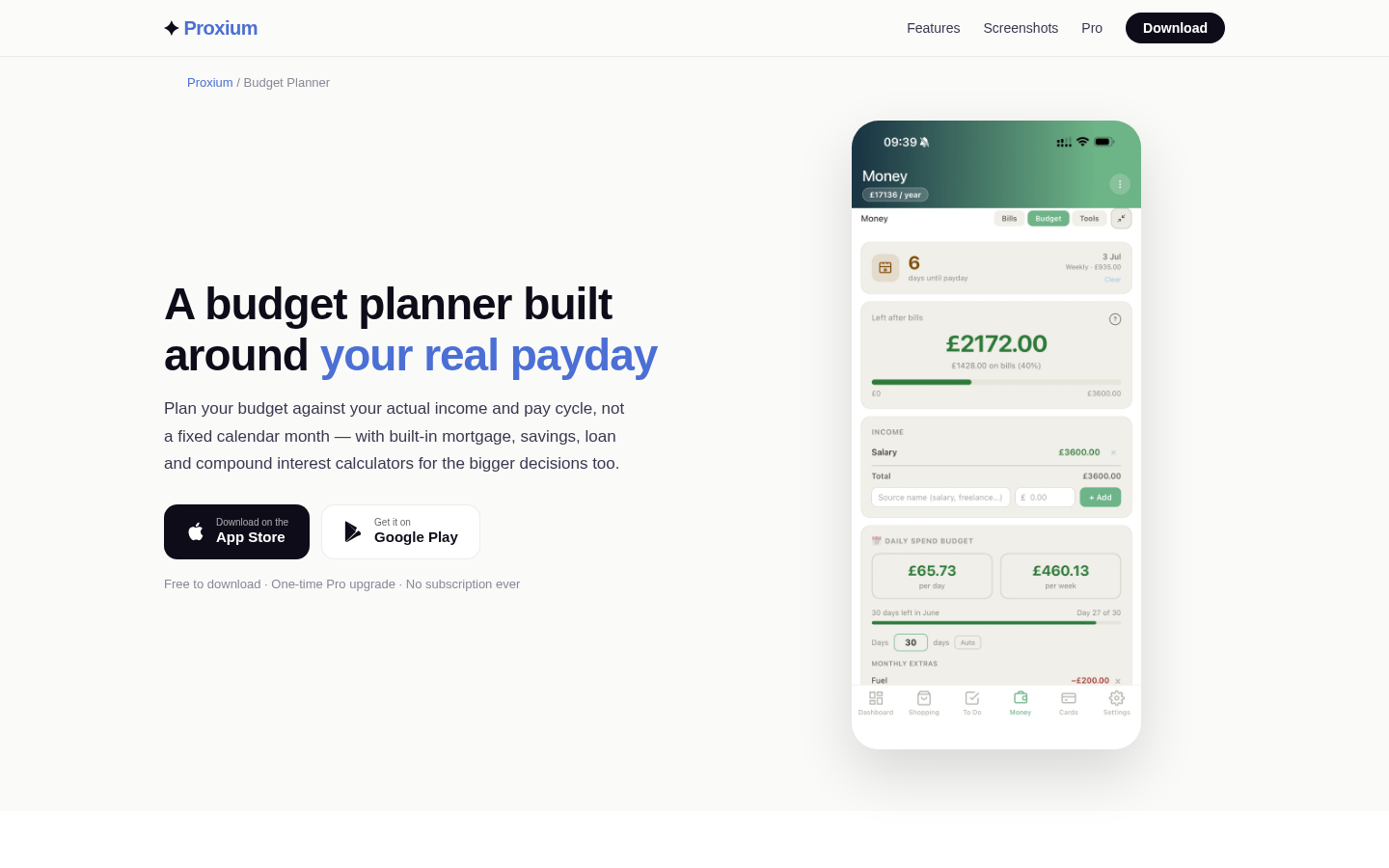
Feature landing page for budget planner with mortgage, salary, savings, and pension calculators.
A spreadsheet can hold the same category totals and pay-cycle notes without adding another app, but you maintain every formula, update and reconciliation yourself.
If your records already live somewhere you actually open, keep using it. If bills, pay-cycle planning and savings sit in separate places, put them together before the next pay cycle starts, and check the plan once a month rather than once a year.